
The best kitchen lighting is layered: ambient light for the whole room, task lighting over every surface you work on, and accent light to give the space depth after dark. In a Malaysian home, use warm white where you sit and eat, a brighter, neutral white where you cook, and decide where every light goes before the ceiling and the cabinets are built. Good lighting makes a kitchen safer to cook in and better to live in, and it costs least when it is planned early.
This guide explains the different types of kitchen lighting, how to light each part of the kitchen, which colour of light to choose, and the mistakes we see most often, with ideas from our own projects. Every photograph is a kitchen Blaine Robert Design has completed in Malaysia. For layouts and the wet and dry kitchen split, start with our kitchen design guide.
Key takeaways
- A layered lighting plan combines ambient, task and accent lighting, and the right lighting depends on what happens in each part of the room.
- Under cabinet lighting is the most useful single upgrade: it removes the shadows your body and the wall cabinets cast on the worktop.
- Warm white (2700K to 3000K) suits the dry kitchen and the dining end; a neutral white (around 4000K) suits the cooking zone.
- Choose fittings with a Colour Rendering Index (CRI) of 90 or higher for task lighting, so food, stone and timber look true.
- Put every switch, dimmer and LED driver on the drawings before the ceiling is closed.
Why good lighting matters in a kitchen
A kitchen is the room you use most, often from early morning to late evening, and good lighting decides whether it works. Kitchen lighting design must consider both function and looks. Task lighting reduces shadows in kitchen work areas, so you can see the knife, the chopping board and the hob clearly, and that is what keeps cooking safe. It also lets you read a recipe on your phone or a tablet on a kitchen stand, or the label on a jar, without leaning into the light.
The same light shapes the mood of the room. In many Malaysian homes the kitchen opens to the dining room or the living hall, so the lights in the kitchen are part of family life and seen by friends all evening. Picture the kitchen at night: a plan that only delivers brightness makes the space feel like a workshop; a plan with layers lets the kitchen work hard at six o'clock and feel calm at nine.
The different types of kitchen lighting
There are three layers, and every well-lit kitchen uses all three. Think of them as the different types of light a room needs, not as different fittings.
General lighting: the ambient layer
Ambient lighting provides the overall lighting for the kitchen: an even light that lets you move around safely. Its job is to illuminate the whole space, not one counter. Recessed ceiling lights and pendant fixtures are the most common way to provide it. In Malaysian condos, recessed downlights in a lowered ceiling are the usual choice, because they give a clean, modern look and leave the ceiling uncluttered. In a landed home with a higher ceiling, a cove that shines up onto a tray can wash the ceiling with indirect light, which is softer than direct lighting from bare downlights alone. Our ceiling design guide shows how coves and trays carry this layer.
Task lighting: focused light where you work
Task lighting is focused light aimed at specific areas: the worktop, the sink, the hob and the island. Good task lighting ensures safety while cooking, and it should be glare-free, so the light shines on the work and not into your eyes. Downlights placed too far back throw a shadow onto the counter, which is why under cabinet lighting and well-placed spots over the island matter more than adding extra ceiling lights.
Accent lighting: depth and personality
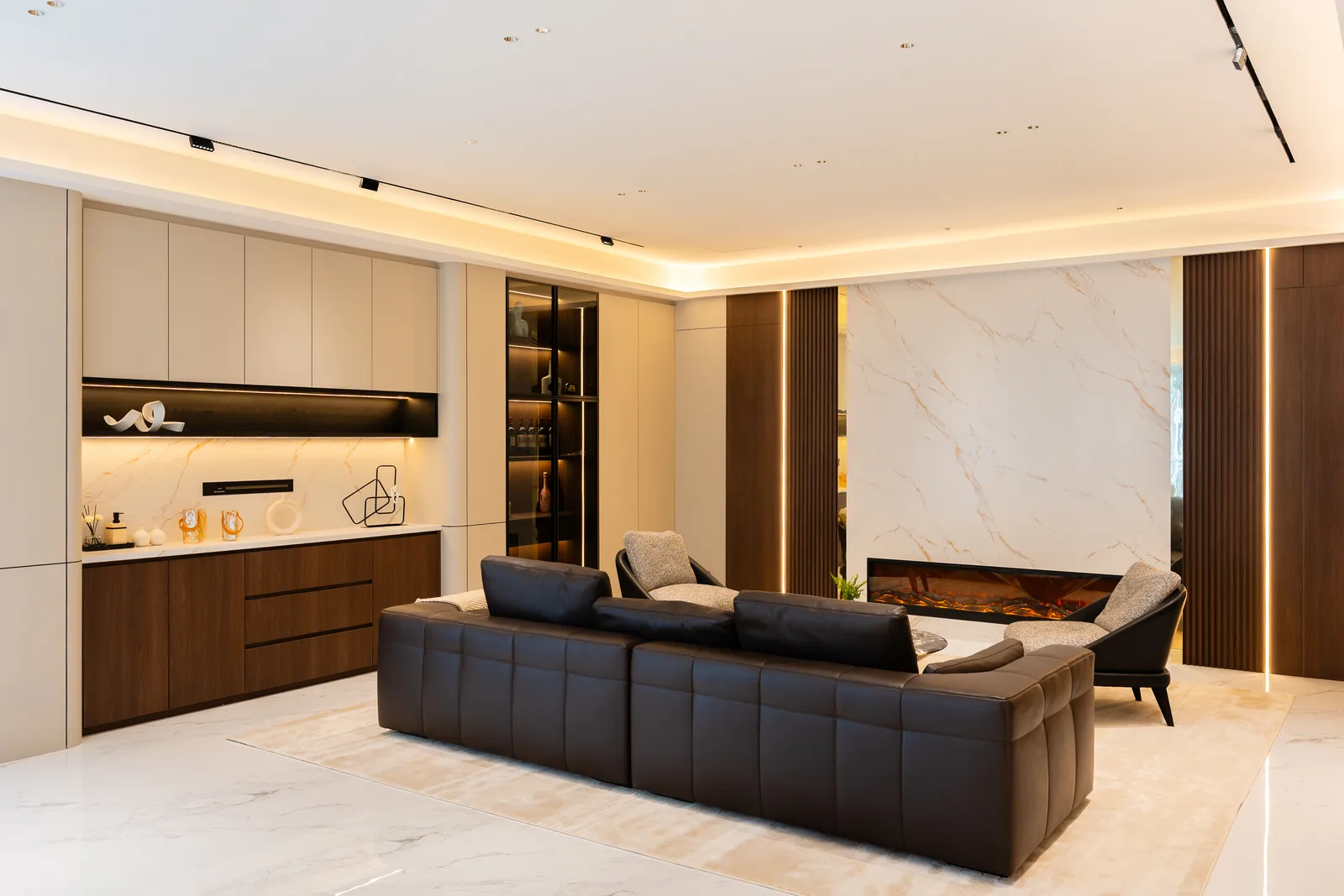
Accent lighting adds depth and personality to a kitchen. Lighting inside glass-fronted kitchen cabinets, under open shelves or along a feature wall picks out the materials and gives the room a warm glow in the evening. Statement lighting fixtures add character and a unique style: a dazzling crystal piece over the island adds artistic style and can be the one thing people remember. Lit shelves and a statement pendant add personality without adding clutter. Accent light is the layer most homes skip, and it is the one that makes a kitchen look finished and helps create the evening mood.
Lighting each part of the kitchen
The right lighting depends on the zone. Plan the kitchen as a set of work areas, think about the nature of each one, and give each its own circuit to create flexibility.
Under cabinet lighting below the kitchen cabinets
Under cabinet lighting eliminates shadows for safer food preparation, with strips that illuminate the worktop exactly where you chop, pour and read. LED strips and puck lights are the popular choices for under-cabinet lighting. A continuous LED strip in an aluminium profile gives the most even light along a long run, with no hot spots on a glossy stone or tile backsplash; puck lights suit shorter runs and display shelves.
When you plan it, you will discover two details make the difference. Fit the strip towards the front edge of the kitchen cabinets, so it lights the worktop rather than the wall. And use a diffuser, because a bare LED reflected in a polished stone countertop is glare, not light. Plan the wiring with the joinery: our kitchen cabinet design guide covers lit glass cabinets and the cabinet layout that decides where the strips can run.
The kitchen island and pendant lights
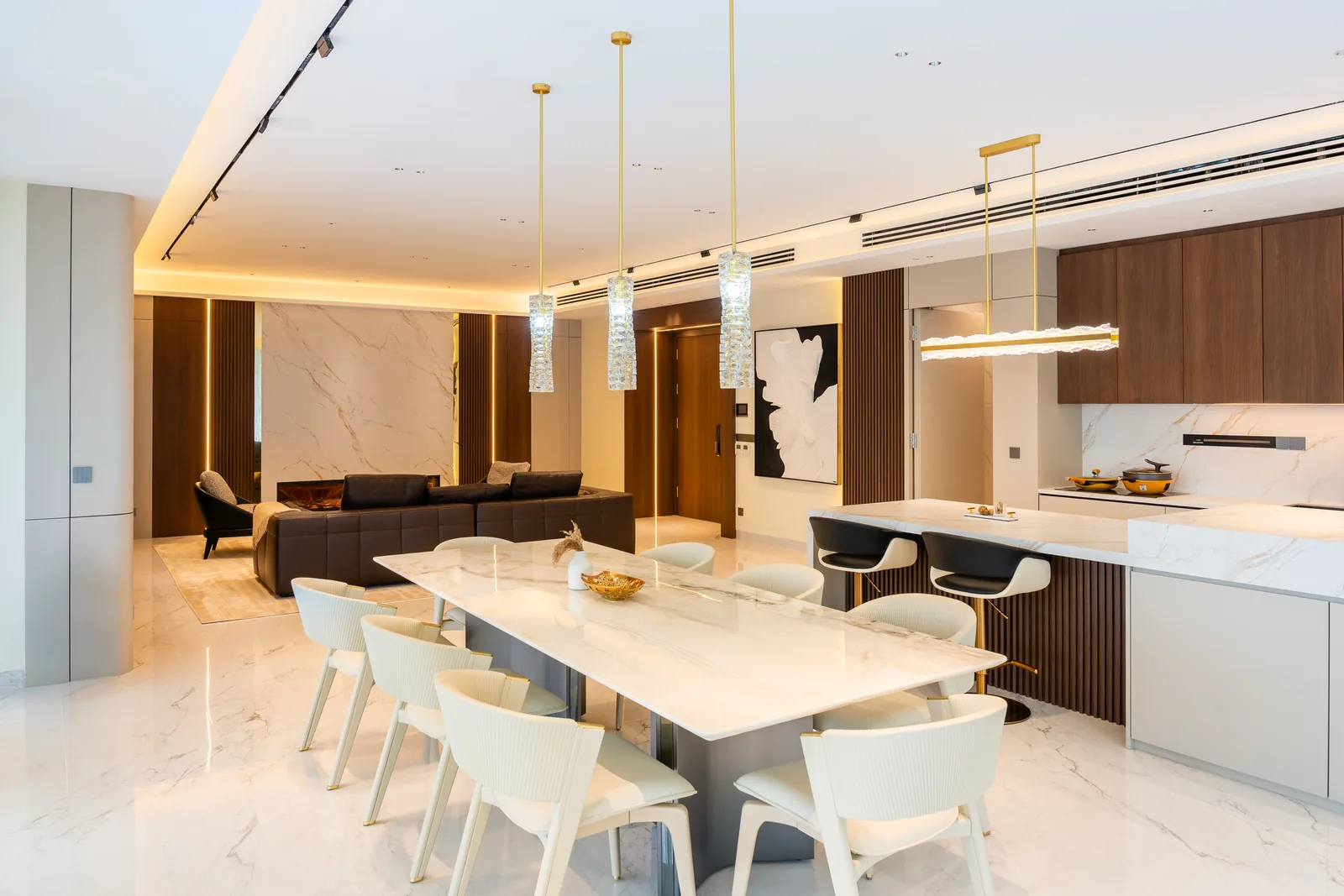
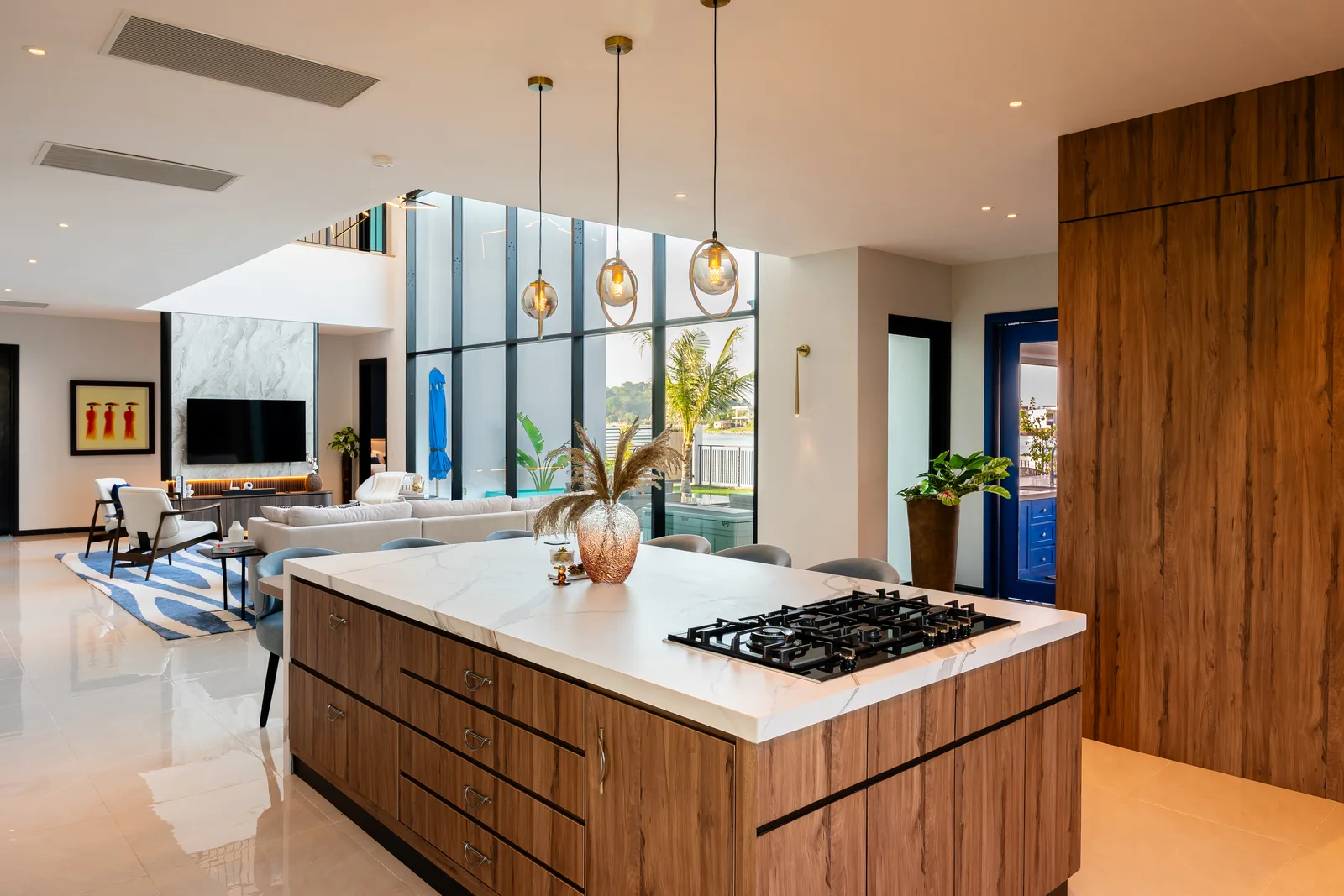
Pendant lights serve as both functional and decorative elements. Over a kitchen island or a dining table they light the surface and create a stylish focal point for the whole room. Three pendants in a row suit a long island; one linear pendant or a sculptural piece suits a short or curved one. Different styles of pendants suit different kitchen designs: elegant glass and brass in a classic kitchen, a slim linear fitting in a minimal one. The right pendant gives a kitchen a unique style of its own. An antique Italian pendant can sit comfortably in a modern kitchen too, when its shape echoes something else in the room.
Hang them so they light the counter without blocking sight lines across the island. Our kitchen island design guide covers island lighting with the island itself, and our guide to kitchen pendant lights covers pendant styles, heights and spacing.
The dry kitchen and the dining area
The dry kitchen is often on show to friends, so light it like a living space. Warm light from pendants over the counter or the table, dimmable downlights and lit display cabinets create a sophisticated environment for guests. Pendants over a dining table are usually hung around 60 to 75 cm above the tabletop, low enough to pool light on the table and high enough to keep faces visible. Our dining room design guide covers the dining end of an open-plan kitchen, and how to complement the kitchen lights with the dining pendant.
The wet kitchen
The wet kitchen is where the heavy cooking happens, so it needs brighter, cooler light and fittings suited to steam and splashes. Choose fittings with a suitable ingress protection (IP) rating for the area around the sink and hob; an IP44 fitting, for example, is protected against splashing water. Keep the light even across the whole space, because a wet kitchen is a working room first. For the hood, the exhaust fan and cross-ventilation, see our wet kitchen design guide.
Toe-kick and night lighting
Toe-kick lighting, a low strip under the base cabinets or the island, is enough to illuminate the floor. It provides a gentle glow and helps you find your way at night without the power of the full lighting. It is the light you leave on when the rest of the kitchen is off, and it makes heavy cabinetry look like it floats.
Natural light comes first
Natural light enhances the ambience and comfort of a kitchen and brings a sense of nature indoors, and kitchens with windows feel more open and inviting. Positioning the work areas near windows maximises natural light, which reduces the need for artificial lighting during the day. Keep the window clear of tall cabinets if you can, and use pale, reflective surfaces to carry daylight deeper into the room.
In a landed home, a skylight or a clerestory window is an effective way to increase natural light in a kitchen that sits in the middle of the plan. In the tropics, shade it well: Malaysian sun brings heat as well as light, so a skylight needs a deep reveal, a tinted or laminated glass, or both. Electric light then only has to finish the job.
Choosing the colour of light: warm, neutral or cool
Colour temperature is measured in kelvin (K). Using warm white light between 2700K and 3000K creates an inviting atmosphere, which suits the dry kitchen, the dining end and any kitchen that opens to the living room. A neutral white of around 4000K suits the wet kitchen and the main worktops, where you need to see colour and detail clearly. Avoid mixing several colour temperatures in one view: one warm and one neutral, used in separate zones, is plenty.
Colour rendering matters as much as colour temperature. A Colour Rendering Index (CRI) of 90 or higher is the usual recommendation for task lighting, because it shows food, marble and timber in their true colours. Modern LED lights can mimic natural light closely for a cosy feel, but only good-quality LEDs with a high CRI do it well.
| Zone | Light | Colour |
|---|---|---|
| Dry kitchen and dining | Pendants, dimmable downlights, lit cabinets | Warm white, 2700K to 3000K |
| Main worktop | Under cabinet lighting, downlights over the counter | Neutral white, about 4000K, CRI 90+ |
| Wet kitchen | Even downlights or panels, splash-rated near water | Neutral white, about 4000K |
| Island | Pendants plus recessed spots | Warm or neutral, matched to the room |
| Night | Toe-kick strip | Warm white |
Kitchen lighting fixtures: what is commonly used
A hanging kitchen light is called a pendant light. There is a wide range of fixtures, and the different types of lighting fixtures commonly found in kitchens are:
- Recessed downlights: the base of the ambient layer; a clean, modern look.
- Pendants: over islands, counters and dining tables.
- Track and spot lights: adjustable task light, useful where the layout may change.
- LED strips and profiles: under cabinets, in coves, inside shelves and at toe-kick level.
- Puck lights: small round lights for cabinets and short runs.
- Wall lights: a softer option over open shelving or a breakfast bar.
- Chandeliers and sculptural pieces: a statement over a large island or the dining table; our chandelier guide covers sizes and styles.
LED lighting is the most popular choice for kitchens today. According to the US Department of Energy, residential LEDs, especially ENERGY STAR rated products, use at least 75% less energy and last up to 25 times longer than incandescent lighting. Dimmable LED lights also let you adjust brightness for different situations, and running them dimmed saves more energy than leaving non-dimmable lights at full power.
Light fixtures should match the overall kitchen style for a cohesive design, so choose finishes that complement the hardware, the taps and the furniture, and colours that complement the stone. Together they create one finished room. The best fittings are stylish and practical at once. For a luxury kitchen in Kuala Lumpur, sculptural crystal of the kind Lasvit has installed in Kuala Lumpur, pendants from houses such as Flos and Louis Poulsen, and kitchens from bulthaup, with its showroom at The Gardens Mall, show how light and joinery are designed together.
Smart lighting systems and controls
Dimmers allow a smooth transition between lighting moods in a kitchen: full brightness for cooking, a lower level for dinner, and just the accent layer late at night. Put each layer on its own circuit and dimmer, so you can control them separately. Smart lighting systems go further, with scenes that change the whole kitchen with one button or a phone, and sensors that switch on under cabinet lighting when you open a door. In high-end work, the best technology is the one you forget is there. Our smart kitchen guide covers connected appliances.
Check that every LED driver is compatible with the dimmer you choose; a mismatch causes flicker, and it is cheaper to fix on paper than after handover.
Kitchens we have lit
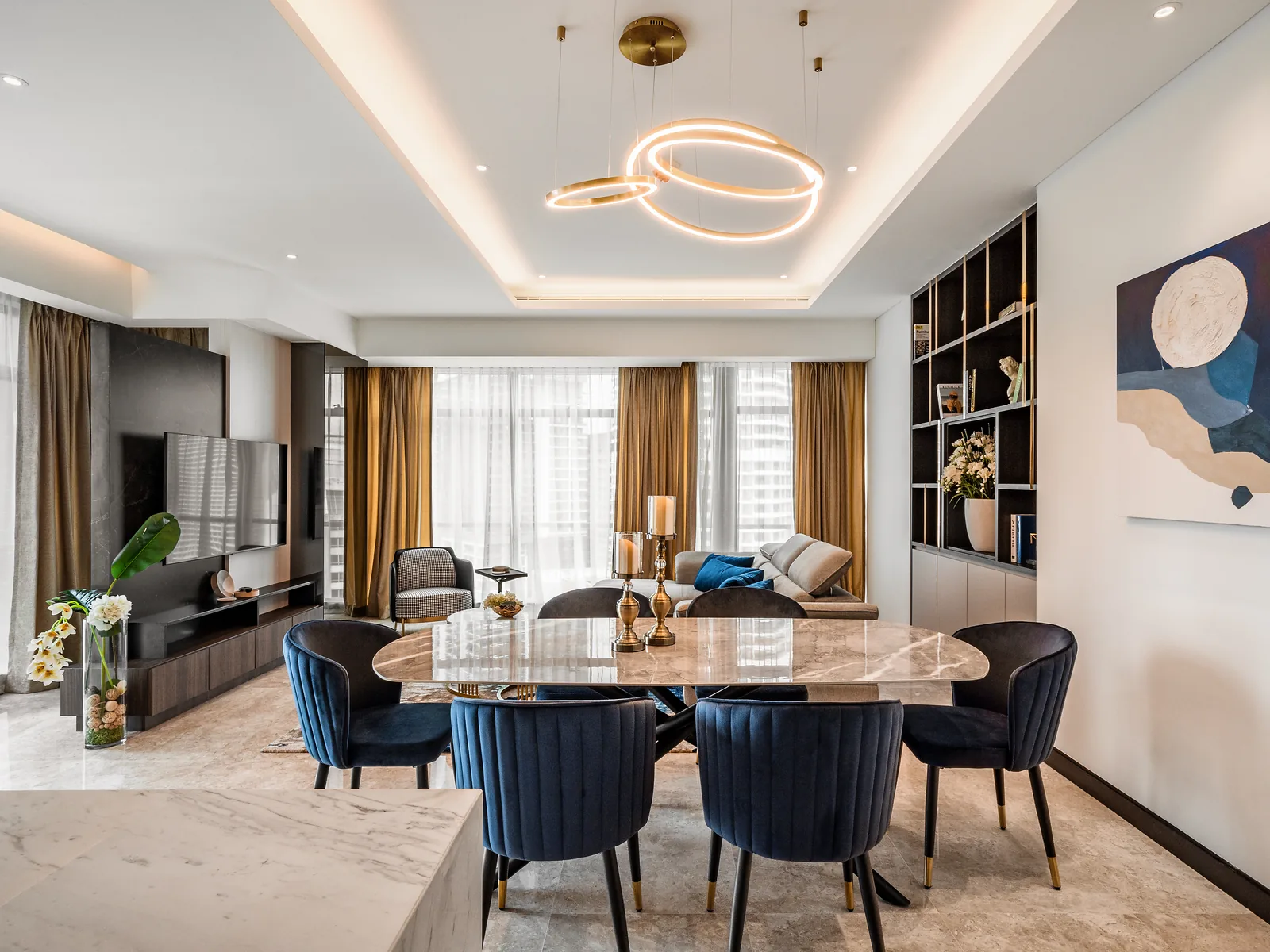
- **Park Regent, Desa ParkCity:** a luxury condominium unit where linear and glass pendants hang over the island and dining table, with a lit cove framing the ceiling.
- **Quayside Villa, Port Dickson:** a luxury bungalow we designed and built, with glass pendants over a working island.
- **The Ritz-Carlton Residences, KLCC:** a luxury show unit fitted out turnkey, where a ring pendant inside a lit cove anchors the dining table beside the open kitchen.
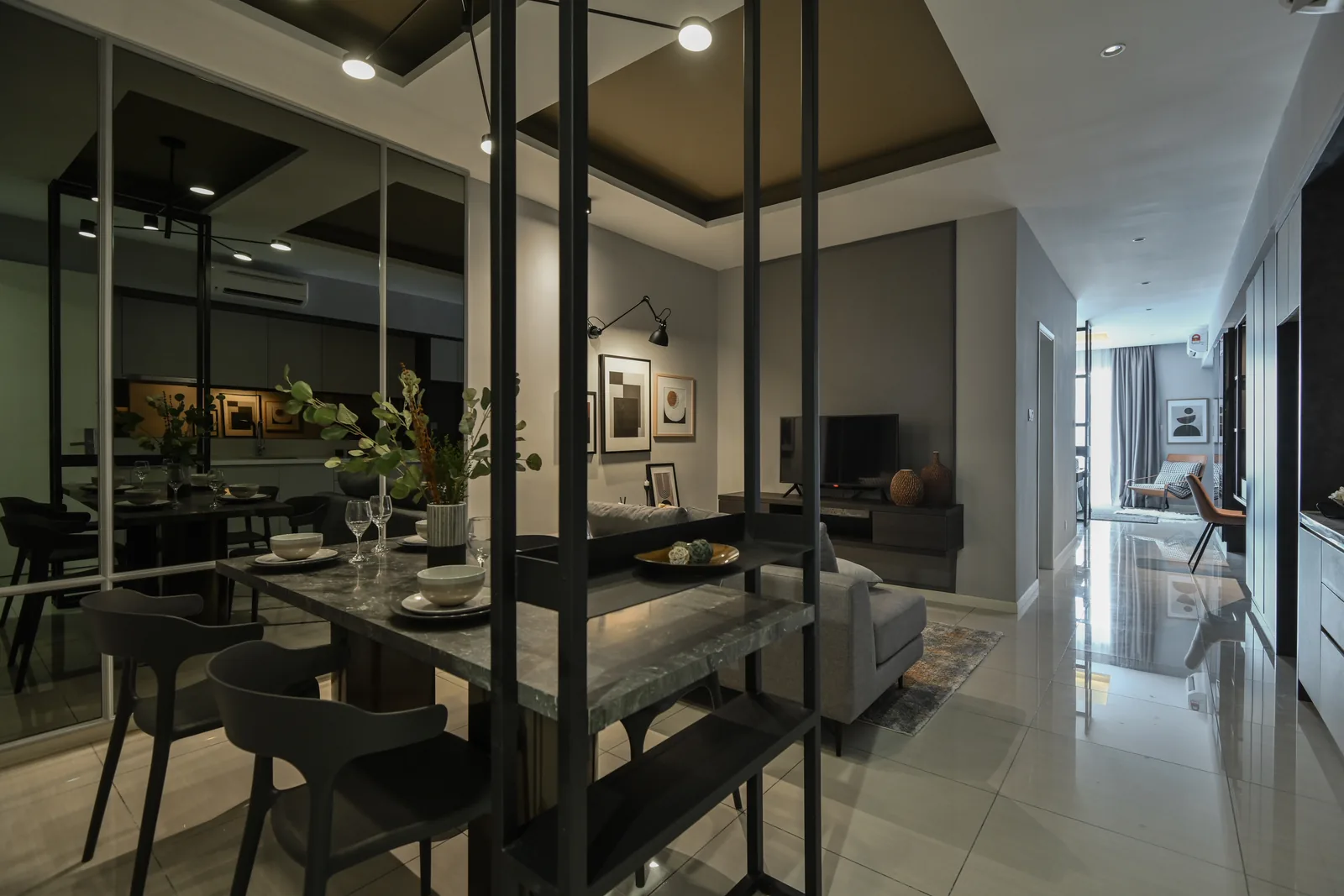
- **Dorsett Hartamas, Sri Hartamas:** a show unit where track spotlights light the dining table and a glass partition beside a compact open kitchen.
- **Kelana Jaya Villa:** a landed home with a cluster of pendants over the island, dark cabinetry and open shelving.
Explore more completed kitchens in our project gallery.
Common kitchen lighting mistakes
- Relying on one ceiling light. A single central fitting puts you in your own shadow at every counter.
- Downlights in a grid. Ceiling lights laid out evenly across the room light the floor, not the work areas. Place them over the counters.
- No under-cabinet light. The most common gap, and the hardest to add once the kitchen cabinets and backsplash are in.
- Glare from shiny surfaces. Bare LEDs over polished stone or a glossy backsplash reflect straight into your eyes. Use diffusers and angle the light.
- Mixing colours of white. Cool panels next to warm pendants make both look wrong.
- Pendants hung too high or too low. Too high and they light the ceiling; too low and they block the view across the island.
- Forgetting the switches. A switch behind the door or at the wrong end of the room is a daily irritation.
How to add lighting to your kitchen: plan it before the plaster
The cheapest time to get kitchen lighting right is before the ceiling closes. Moving a light on a drawing costs nothing; moving it after the ceiling is plastered and painted means hacking, patching and repainting. A short lighting plan:
- List what happens where. Cooking, prep, washing up, eating, homework, coffee in the morning.
- Mark the work areas and give each a task light.
- Add the ambient layer with downlights or a cove, placed over the counters rather than in a grid.
- Choose the accent pieces: a pendant over the island, lit cabinets, toe-kick strips.
- Set the colour temperature for each zone and keep it consistent.
- Put each layer on its own circuit and dimmer, and mark the switch positions at the entrances.
- Coordinate with the joinery: cable routes and drivers for under-cabinet strips must be built into the kitchen cabinets.
If you are adding lighting to an existing kitchen, under-cabinet LED strips are the easiest upgrade, and plug-in or battery puck lights can light shelves without new wiring. For anything wired, use a licensed electrician.
When we design and build a home, the lighting plan is drawn with the ceiling, the joinery and the electrical layout, so nothing is moved on site. See our residential interior design service and our design and build service, or explore the home interior design guide for the rest of the house. For a compact kitchen, our small kitchen design guide shows how light makes a small space feel larger.
Frequently asked questions
What type of lighting is best for a kitchen?
A layered scheme is best: ambient lighting for the whole room, task lighting over the worktop, sink, hob and island, and accent lighting for depth. In practice that means recessed downlights or a cove, under cabinet lighting, and one or more pendant lights.
How bright should kitchen lighting be?
Brighter at the worktop than anywhere else. Aim for even, shadow-free light on every surface where you prepare food, with dimmable ambient and accent layers for the rest of the room, and choose LEDs with a CRI of 90 or higher so colours look true.
Should I use warm white or cool white in my kitchen?
Use warm white (2700K to 3000K) in the dry kitchen and where you eat, and a neutral white (about 4000K) over the main worktops and in the wet kitchen. Keep each zone to one colour temperature.
What is a hanging kitchen light called?
A pendant light. Pendants hang from the ceiling on a cord, chain or rod, usually over an island, a counter or a dining table.
Can I add under cabinet lighting after my kitchen is installed?
Yes. LED strips in a slim aluminium profile or puck lights can be added to most existing wall cabinets. The neatest result comes when the cable route and the driver position are planned with the cabinets, so ask for this at the design stage if you can.
Do I need special lights for a wet kitchen?
Use brighter, neutral-white light for heavy cooking, and choose fittings rated for splashes near the sink and the hob. Keep fittings away from direct steam where possible, and pair the lighting with good ventilation.
What are the kitchen lighting trends for 2026?
Integrated light: LED profiles built into cabinets, shelves and ceiling coves rather than added fittings, warm and dimmable scenes, and one sculptural pendant used as a focal point instead of many small ones.
Plan your kitchen lighting with us
The right kitchen lighting is designed, not added at the end. It is part of the bigger picture: the layout, the materials and the way your family lives. If you are planning a kitchen in Kuala Lumpur or the Klang Valley, talk to our team and we will plan the light with the layout, the ceiling and the joinery from the start.